Grain doesn’t disappear all at once. It disappears quietly: in the humidity that builds overnight, in the pests that enter through a poorly sealed joint, in the grain left behind at the bottom of a flat-floor silo after every discharge cycle.
After 50 years of designing and installing grain storage systems across five continents, we’ve learned to read these losses before they happen. Here are five of the most common and preventable.
1️⃣ Moisture damage.
Temperature fluctuations cause condensation inside the silo. Without a well-engineered ventilation system, that moisture accelerates fungal growth and spoilage. A properly designed aeration system keeps grain dry and stable — not just at loading, but throughout the entire storage period.
2️⃣ Incomplete discharge.
Flat-bottom silos rely on sweep augers to extract the last grain from the floor. What the auger misses stays behind, degrades, and contaminates the next batch. In a hopper silo, gravity does the work. Complete discharge. Every cycle.
3️⃣ Pest infiltration.
Insects and rodents don’t need large gaps; they need any gap. A fumigation system is only as effective as the seal around it. SIMEZA engineers its silos to meet the strictest fumigation standards in the world, including Australian regulations, where the tolerance for failure is zero.
4️⃣ Structural stress fractures.
Snow load in Scandinavia, thermal expansion in the Middle East, seismic considerations in parts of Latin America, and a silo that wasn’t designed for its specific environment will show it, eventually. A fractured panel doesn’t just compromise structure; it opens the grain to everything outside.
5️⃣ Handling losses at discharge.
The connection between the silo outlet and the conveying system is one of the most overlooked points of loss. A custom-calculated mechanization outlet, housed in a sheltered chamber away from rain and dust, ensures that grain moves from storage to transport without spilling, without contaminating, and without slowing down the operation.
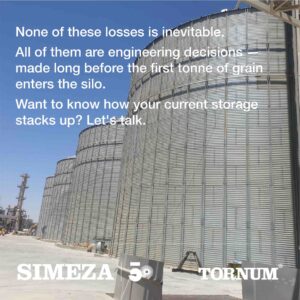
None of these losses is inevitable. All of them are engineering decisions, made long before the first tonne of grain enters the silo.
Want to know how your current storage stacks up?
Let’s talk here