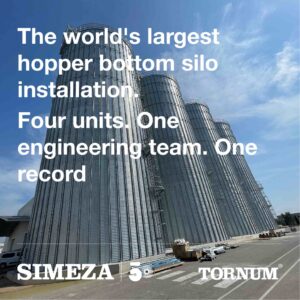
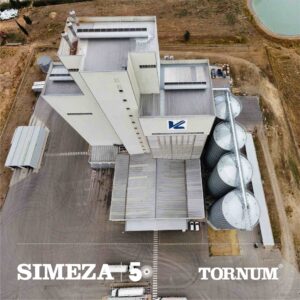
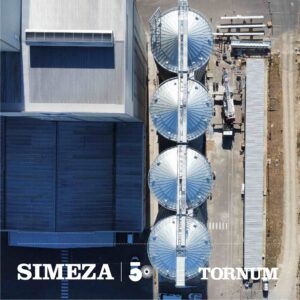
Four hopper bottom silos. 3.000 tM capacity each. 13.8 metres in diameter. 12.000 tM total.
The largest hopper-bottom silo installation ever built.
Numbers like these don’t happen by accident. They are the result of a manufacturing process that scales without shortcuts: steel panels fabricated to specification, structural loads calculated for real operating conditions, and a discharge geometry that works the same on day one as it does a decade later.
Hopper silos are not the obvious choice for installations of this scale. The conventional approach defaults to flat-bottom designs when volumes climb. But gravity discharge doesn’t become less efficient at 3.000 tM. It becomes more important. No sweep augers. No grain residue. No mechanical failure points were introduced to compensate for a design that doesn’t fully empty.
This project is a proof point, not just for SIMEZA, but for what the hopper silo format can achieve when engineering decisions are made without compromise.
Fifty years of installations across five continents have taught us what drawings alone never could. This is what that knowledge looks like in steel.
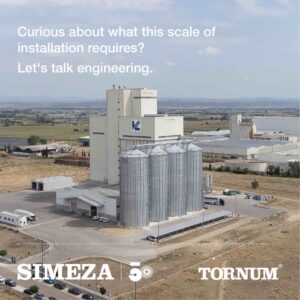
Curious about what this scale of installation requires? Let’s talk engineering here